WhatsApp Marketing for Small Businesses in India: The Complete 2026 Guide
October 5, 2026
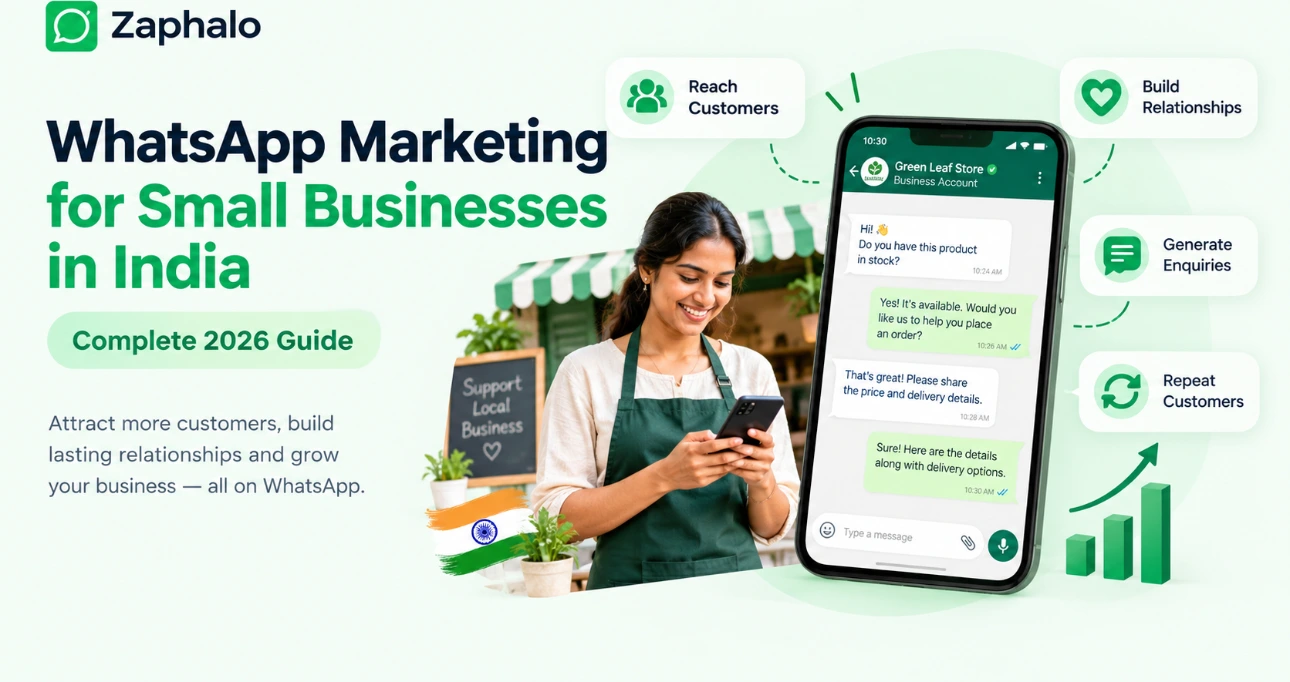
For many small businesses in India, the biggest challenge is not finding customers. It is staying connected with them after they show interest, visit a store, make an enquiry, or complete a purchase.
Customers ask questions, compare options, leave without buying, forget about an enquiry, and sometimes return weeks or months later. For a small business with a limited team, keeping track of all these conversations can quickly become difficult.
WhatsApp can help solve part of this problem because it gives businesses a direct communication channel that customers already know how to use. But successful WhatsApp marketing is not simply about sending promotional messages.
The real opportunity is to use WhatsApp as part of the customer journey: helping people discover your business, answering their questions, making decisions easier, following up at the right time, and staying connected after a purchase.
This guide explains how small businesses in India can build a practical WhatsApp marketing strategy in 2026 without making their communication complicated.
Why WhatsApp Marketing Is Different for Small Businesses
Large companies may have separate teams for marketing, sales, customer support, and customer retention. A small business often has one person handling several of these responsibilities at the same time.
That changes the way WhatsApp should be used.
A small business does not necessarily need more messages. It needs better conversations.
Instead of asking, "How many promotional messages can we send?", a better question is:
"What information does this customer need from us at this stage?"
This simple change in thinking can make WhatsApp communication more useful, more personal, and easier to manage.
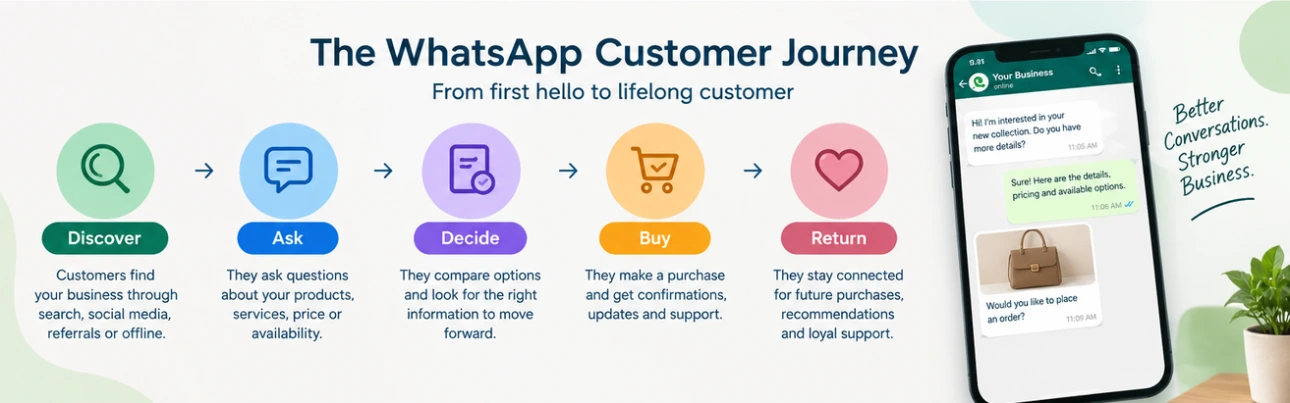
The WhatsApp Customer Journey
One of the easiest ways for a small business to understand WhatsApp marketing is to look at the complete customer journey.
A customer may first discover your business through Google, Instagram, an advertisement, a referral, a physical store, or another channel. WhatsApp can then become the place where the conversation continues.
Stage 1: Discover
The customer becomes aware of your business. Your goal at this stage is to make it easy for interested people to contact you.
Stage 2: Ask
The customer wants more information. They may ask about price, availability, timing, location, features, or the process.
Stage 3: Decide
The customer is comparing options or deciding whether to buy. Clear answers, useful information, and timely communication can reduce friction during this stage.
Stage 4: Buy
Once the customer is ready, WhatsApp can continue to support the purchase journey with confirmations, updates, instructions, or other useful information.
Stage 5: Return
The relationship should not end after one transaction. Businesses can stay connected with customers and give them useful reasons to return.
Thinking about these five stages helps a business decide what to say, when to say it, and who should receive it.

How to Build a WhatsApp Audience
Before thinking about what to send, a business needs people to communicate with. The first step is therefore building a customer audience in a useful and responsible way.
Your existing customer touchpoints can become opportunities to invite customers to connect with your business on WhatsApp.
Use Your Website
Add a clear WhatsApp contact option to important pages of your website. Customers who already have questions can start a conversation without searching for a phone number.
Use Social Media
If customers discover your business through social media, give them a simple way to continue the conversation on WhatsApp.
Use QR Codes
Physical stores, packaging, printed materials, invoices, and promotional displays can use QR codes to make it easier for customers to start a WhatsApp conversation.
Use Existing Customer Interactions
Customers who already interact with your business can become part of a longer-term communication relationship when they have appropriately opted in to receive messages.
The objective should be to build an audience that actually wants to hear from your business rather than collecting as many numbers as possible.
What Should a Small Business Send on WhatsApp?
Not every WhatsApp message needs to be a sale.
A healthy communication mix can include information, assistance, reminders, updates, and occasional promotional content.
Useful Information
Share information that helps customers make decisions or use your products and services more effectively.
Customer Updates
Keep customers informed about relevant changes, appointments, orders, availability, or other updates connected to their interaction with your business.
Helpful Recommendations
Recommend products or services based on what a customer has previously shown interest in instead of sending unrelated promotions.
Special Offers
Promotions can be effective when they are relevant to the recipient and provide a clear reason to take action.
Follow-Ups
A follow-up can be useful when a customer has already shown genuine interest but has not completed the next step.
A Simple 30-Day WhatsApp Marketing Plan
Small businesses do not need to launch a complicated strategy on day one. A simple 30-day plan can help create a consistent process.
Week 1: Understand Your Customers
Identify your most common customer questions, your best customer types, and the points where customers usually need help before making a decision.
Week 2: Create Your Communication Plan
Decide which types of conversations you want to handle through WhatsApp. Prepare useful information for common questions and define when customers should receive follow-ups.
Week 3: Start Conversations
Add WhatsApp to relevant customer touchpoints such as your website, social channels, physical location, and other marketing materials.
Week 4: Review What Happened
Look at the conversations you received. Which questions appeared most often? Where did customers stop responding? Which conversations resulted in sales or appointments?
Use these observations to improve your strategy for the following month.
How Often Should a Small Business Message Customers?
There is no universal number of messages that works for every business. The right frequency depends on the type of relationship, the reason for contacting the customer, and the value of the message.
A useful rule is simple: If the customer would not find the message useful, reconsider sending it.
A business selling products that customers purchase frequently may have more opportunities to communicate than a business selling an occasional service.
Quality and relevance should matter more than simply increasing message volume.
What Should Be Manual and What Should Be Systematic?
Small businesses often begin by managing WhatsApp conversations manually. That is completely reasonable when the number of conversations is small.
The problem starts when the business grows and important conversations become difficult to remember or track.
Keep Personal Conversations Personal
Questions that require judgement, negotiation, recommendations, or a personal response should be handled by the appropriate team member.
Standardize Repetitive Work
Repetitive questions and predictable steps can be organized into a consistent process so employees do not have to recreate the same response every time.
Track Important Follow-Ups
When a business has many enquiries, relying entirely on memory can lead to missed opportunities. A structured process makes it easier to identify conversations that still need attention.
The objective is not to make every interaction automatic. It is to make the overall customer communication process easier to manage.
How to Know if WhatsApp Marketing Is Working
A business should not judge its WhatsApp strategy only by the number of messages it sends.
Instead, look at what happens after the conversation begins.
Conversation Starts
How many potential customers are actually starting conversations with your business?
Qualified Enquiries
How many conversations come from people who genuinely need your product or service?
Response and Follow-Up
Are customers receiving useful responses at the right time?
Business Outcomes
Are WhatsApp conversations leading to purchases, appointments, enquiries, repeat business, or another meaningful business result?
Customer Retention
Are existing customers continuing to engage with the business over time?
These measurements help move WhatsApp marketing away from vanity metrics and toward actual business outcomes.
Common Mistakes Small Businesses Should Avoid
1. Treating WhatsApp Like a Notice Board
WhatsApp is a conversation channel. Businesses should think about the customer response, not just the message they want to send.
2. Sending the Same Message to Everyone
Customers have different needs. A message that is useful for one group may be irrelevant to another.
3. Ignoring Interested Leads
Getting a customer conversation started is only the beginning. Businesses should have a clear process for responding and following up.
4. Communicating Without a Clear Purpose
Before sending a message, identify what you want the customer to understand or do.
5. Forgetting the Customer Experience
A strategy that generates many messages but creates a poor customer experience is not a successful strategy.
6. Ignoring Consent and Platform Requirements
Businesses should communicate responsibly, respect customer preferences, and follow applicable WhatsApp and Meta requirements for business messaging.
When Your WhatsApp Strategy Starts Growing
A small business may begin with a few customer conversations each day. As more customers discover the business, the number of conversations can increase quickly.
At that point, the challenge changes from simply using WhatsApp to managing WhatsApp communication consistently.
Businesses may need a better way to organize customer conversations, coordinate team activity, manage campaigns, create structured customer journeys, and understand how their communication is performing.
This is where a platform such as Zaphalo can become useful.
Zaphalo brings WhatsApp communication tools into one place, helping businesses manage customer conversations, campaigns, automation, and engagement as their communication needs grow.
Instead of treating WhatsApp as just another messaging application, businesses can build it into their wider customer communication process.
WhatsApp Marketing Checklist for Small Businesses
Before starting, make sure you can answer "yes" to these questions:
✓ Do we know who our target customers are?
✓ Do customers have an easy way to contact us on WhatsApp?
✓ Do we know the most common questions customers ask?
✓ Do we have useful information ready for those questions?
✓ Do we have a process for following up with interested customers?
✓ Are our messages relevant to the people receiving them?
✓ Are we respecting customer preferences and messaging requirements?
✓ Can we identify whether WhatsApp is generating meaningful business results?
✓ Do we have a plan for handling more conversations as the business grows?
If most of these answers are yes, your business already has the foundation for a practical WhatsApp marketing strategy.
Conclusion
WhatsApp marketing can be much more than sending offers to customers. For small businesses in India, it can become a practical part of the entire customer journey — from the first enquiry to the next purchase.
The best strategy is not necessarily the one that sends the most messages. It is the one that gives customers useful information at the right time, makes communication easier, and helps the business build lasting relationships.
Start small. Understand your customers, identify the conversations that matter most, create a simple communication process, and measure the results. As your customer base and conversations grow, you can introduce more structured tools to manage the process efficiently.
With the right strategy, WhatsApp can become a valuable customer communication channel for Indian small businesses in 2026.
Ready to Grow Your Business With WhatsApp?
Build better customer conversations and manage your WhatsApp communication with Zaphalo.
14-day free trial • Cancel anytime