WhatsApp Marketing in India: Complete Guide for Businesses in 2026
September 18, 2026
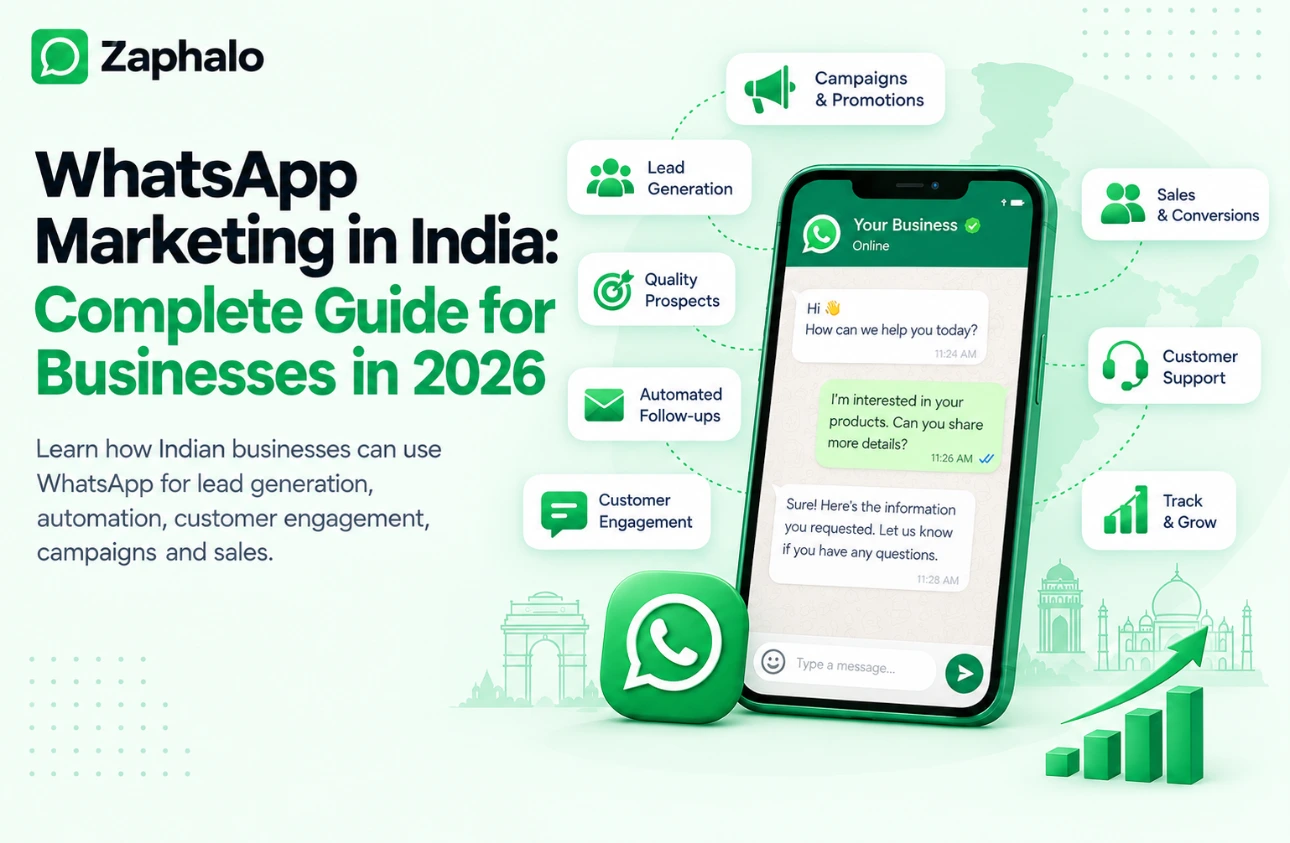
WhatsApp has become an important communication channel for businesses that want to connect with customers quickly and conveniently. From small businesses and startups to growing sales teams, companies use WhatsApp to answer questions, share information, follow up with prospects, and support customers.
In India, businesses across industries are increasingly using conversational communication to connect with customers throughout the buying journey.
WhatsApp marketing is not simply about sending messages. A successful strategy combines customer conversations, useful content, lead generation, automation, follow-ups, and responsible messaging.
In this guide, we'll explain what WhatsApp marketing is, how it works, the different strategies businesses can use, and how automation can help create a more organized customer journey.
What Is WhatsApp Marketing?
WhatsApp marketing is the use of WhatsApp as a business communication channel to engage customers and prospects.
Businesses can use WhatsApp to communicate with people who have shown interest in their products or services, provide information, answer questions, send relevant updates, and support customers throughout their journey.
Depending on the business and its communication requirements, WhatsApp can support activities such as:
- Lead generation
- Customer enquiries
- Product and service information
- Appointment and booking communication
- Customer support
- Follow-up conversations
- Marketing campaigns
- Automated conversations
- Order and service updates
Why WhatsApp Marketing Matters for Indian Businesses
Businesses need communication channels that are convenient for customers and practical for sales and support teams.
WhatsApp can create a direct conversational path between a customer and a business. Instead of moving between multiple communication channels, customers can start a conversation and continue it in the same environment.
This makes WhatsApp useful for businesses that depend on enquiries, consultations, bookings, demonstrations, sales conversations, or ongoing customer relationships.
Direct conversations
Customers can communicate directly with a business instead of searching for contact information or waiting for a traditional response.
Faster communication
Businesses can acknowledge enquiries quickly and provide customers with the information they need at the right stage of their journey.
Conversational customer journeys
Customers can ask questions, explain their requirements, and continue the conversation instead of completing a long sequence of forms.
Easier follow-ups
Sales teams can continue conversations with prospects and customers when appropriate, helping keep communication organized.
WhatsApp Business vs WhatsApp Business Platform
One of the first decisions a business needs to make is choosing the right WhatsApp setup for its communication needs.
Smaller businesses may begin with the WhatsApp Business application for direct customer communication.
Businesses with larger teams, higher conversation volumes, automated workflows, integrations, or more advanced communication requirements may need the WhatsApp Business Platform and suitable business software.
The right choice depends on factors such as team size, conversation volume, automation requirements, integrations, and the way the business manages customer communication.
Before choosing a solution, businesses should evaluate their communication process rather than choosing a tool only because it has more features.
WhatsApp Marketing for Lead Generation
WhatsApp can become an important part of a lead-generation strategy when businesses make it easy for interested customers to start conversations.
A typical WhatsApp lead-generation journey can look like this:
- A customer discovers the business.
- The customer sees a website button, advertisement, QR code, social media post, or other call to action.
- The customer starts a WhatsApp conversation.
- The business collects the information needed to understand the enquiry.
- The lead is qualified.
- The sales team follows up.
- The customer completes the desired action.
The important part is not simply generating more conversations. Businesses should also have a process for handling, qualifying, assigning, and following up with those conversations.
7 WhatsApp Marketing Strategies for Businesses
Businesses can use different WhatsApp strategies depending on their goals and customer journey.
1. Add WhatsApp to Your Website
Add a clear WhatsApp call-to-action to important pages of your website.
Visitors with questions about pricing, services, products, availability, or implementation can start a conversation directly.
2. Use Click-to-WhatsApp Campaigns
Advertising campaigns can encourage potential customers to start a WhatsApp conversation instead of sending them through a longer journey before they can contact the business.
This approach can be useful when the product or service requires questions, consultation, or sales assistance.
3. Use QR Codes
QR codes can connect offline marketing with WhatsApp.
Businesses can place WhatsApp QR codes on brochures, packaging, posters, business cards, product displays, invoices, events, or physical stores.
4. Create Useful Campaigns
Marketing messages should provide a clear reason for the customer to engage.
Depending on the business, campaigns can communicate product information, announcements, educational content, offers, reminders, or other relevant updates.
5. Automate Frequently Asked Questions
Businesses receive many repetitive questions.
Automation can help provide initial answers to common questions and collect basic information before a human agent takes over.
6. Automate Lead Follow-Ups
Following up with leads manually can become difficult as the number of conversations grows.
Businesses can create structured workflows for appropriate follow-ups while keeping a human handover available when the conversation requires personal attention.
7. Connect WhatsApp With Customer Management
When conversations are managed separately from customer records, sales teams may lose important context.
Connecting WhatsApp communication with customer-management processes can help teams organize conversations and follow-ups more effectively.
How WhatsApp Automation Works
WhatsApp automation allows businesses to handle specific parts of customer communication using predefined workflows.
A simple automated journey could look like this:
- Customer starts a conversation
- Automated welcome message is sent
- Customer selects a requirement
- Relevant information is provided
- Additional questions qualify the enquiry
- Conversation is assigned to the appropriate team
- Sales or support representative takes over
Automation should support the customer experience rather than make every conversation feel robotic.
The best workflows usually combine automation for repetitive tasks with human assistance for complex questions.
WhatsApp Chatbots for Businesses
A WhatsApp chatbot can handle the first stage of a conversation and help customers find information quickly.
Depending on the business process, a chatbot can:
- Welcome new enquiries
- Answer frequently asked questions
- Collect customer information
- Identify customer requirements
- Provide product or service information
- Qualify leads
- Route conversations to a team
- Transfer conversations to a human agent
Chatbots are especially useful when businesses receive similar questions repeatedly or need to collect structured information before a salesperson becomes involved.
WhatsApp Marketing Examples by Industry
WhatsApp marketing can be adapted to different customer journeys. The workflow should depend on what the customer needs from the business.
Real Estate
Real estate businesses can use WhatsApp to handle property enquiries, collect buyer requirements, share relevant information, schedule conversations, and follow up with prospects.
Education
Educational institutions and training businesses can use WhatsApp to answer course enquiries, collect student requirements, share information, and connect prospective students with counsellors.
Ecommerce
Ecommerce businesses can use WhatsApp for customer communication, product enquiries, order-related updates, campaigns, and customer support.
Healthcare and Clinics
Clinics and service providers can use appropriate WhatsApp communication for enquiries, appointment-related communication, reminders, and customer support while following applicable privacy and communication requirements.
Service Businesses
Service businesses can use WhatsApp to collect enquiries, understand customer requirements, schedule discussions, and maintain follow-up conversations.
How to Create Better WhatsApp Campaigns
Sending more messages does not automatically create better marketing results.
A good WhatsApp campaign starts with a clear objective and a relevant audience.
Define the objective
Decide what the campaign is trying to achieve. For example, the objective could be generating enquiries, promoting a service, encouraging bookings, or communicating an important update.
Segment your audience
Different customers have different interests and requirements. Segmenting audiences can make communication more relevant.
Keep the message clear
Customers should quickly understand why they are receiving the message and what action they can take.
Use a clear call to action
Tell the customer what to do next, such as starting a conversation, requesting information, booking a service, or visiting a relevant page.
Measure the campaign
Track meaningful outcomes such as conversations, qualified leads, responses, bookings, and conversions rather than focusing only on the number of messages sent.
WhatsApp Lead Management: What Happens After the Message?
Generating a WhatsApp conversation is only the beginning.
Businesses need a clear process for what happens after a customer sends a message.
A simple lead-management process can include:
- Capture the conversation
- Identify the customer
- Understand the requirement
- Qualify the lead
- Assign the conversation
- Follow up
- Track the outcome
Without this process, sales teams may have many conversations but limited visibility into which leads require action.
Why Businesses Need a Shared WhatsApp Inbox
When one person manages all WhatsApp conversations, the process may work initially. As a business grows, multiple sales or support employees may need access to the same customer conversations.
A shared inbox can help teams:
- Organize customer conversations
- Assign chats to team members
- Reduce duplicate responses
- Track conversations
- Maintain customer context
- Coordinate sales and support teams
Centralizing conversations can become especially useful when several employees communicate with customers through WhatsApp.
WhatsApp Marketing Best Practices
A sustainable WhatsApp marketing strategy should focus on relevance, customer experience, and responsible communication.
- Make it easy for customers to start a conversation.
- Clearly communicate why customers are receiving messages.
- Send relevant and useful information.
- Avoid unnecessary or excessive messaging.
- Keep automated conversations simple.
- Provide a way to reach a human when necessary.
- Organize leads and conversations.
- Track meaningful business outcomes.
- Use appropriate consent and messaging practices.
- Follow applicable WhatsApp Business Platform policies and privacy requirements.
Common WhatsApp Marketing Mistakes
Sending the same message to everyone
Customers have different needs. Sending identical messages without considering customer context can make communication less useful.
Focusing only on message volume
More messages do not necessarily mean more customers. Businesses should focus on conversations and outcomes that matter.
Ignoring follow-ups
A customer who does not purchase immediately may still be interested. A structured follow-up process can help businesses manage these opportunities.
No human handover
Automation is useful for repetitive tasks, but complex questions may require a human sales or support representative.
Not tracking results
Without measurement, businesses cannot easily understand which campaigns, conversations, or workflows are contributing to business outcomes.
WhatsApp Marketing Metrics to Track
Businesses should measure WhatsApp marketing based on their actual objectives.
Useful metrics can include:
- Number of conversations started
- Number of enquiries
- Qualified leads
- Response rates
- Follow-up activity
- Bookings or appointments
- Sales opportunities
- Conversions
- Customer support resolution
The right metrics depend on whether WhatsApp is being used for marketing, sales, support, or a combination of these activities.
How Zaphalo Helps With WhatsApp Marketing
Managing WhatsApp communication manually can become difficult as the number of customer conversations increases.
Zaphalo helps businesses organize WhatsApp communication through automation, conversational workflows, customer management, and team collaboration.
Businesses can use Zaphalo to create structured customer journeys instead of handling every conversation manually.
AI-powered conversations
Automate common conversations and provide customers with quick responses to frequently asked questions.
Automated workflows
Create workflows for enquiries, lead qualification, follow-ups, and other customer communication processes.
Shared team communication
Give teams a centralized environment for managing customer conversations and coordinating follow-ups.
Lead management
Organize conversations and help sales teams manage customer interactions throughout the sales journey.
Targeted communication
Create more relevant customer communication based on available customer information and business requirements.
How to Start WhatsApp Marketing for Your Business
If your business is new to WhatsApp marketing, you do not need to automate everything immediately.
Start with a simple process:
- Define your business objective.
- Identify the type of customers you want to communicate with.
- Choose the appropriate WhatsApp business setup.
- Create a clear way for customers to start conversations.
- Prepare useful responses to common questions.
- Create a lead qualification process.
- Define how sales or support teams will handle conversations.
- Add automation where repetitive tasks are slowing down your team.
- Track conversations and business outcomes.
Once the basic process is working, businesses can gradually introduce more automation and integrations.
Conclusion
WhatsApp marketing can give businesses a direct way to communicate with customers throughout the buying and support journey.
Businesses can use WhatsApp for lead generation, customer enquiries, campaigns, follow-ups, automated conversations, customer support, and other communication workflows.
The most effective approach is not simply sending more messages. Businesses should build a clear customer journey that makes it easy for people to start conversations, receive useful information, get the right support, and take the next step.
As conversations grow, automation, organized lead management, and centralized team communication can help businesses manage WhatsApp more efficiently.
If your business wants to turn WhatsApp conversations into organized customer journeys, Zaphalo can help bring communication, automation, and lead management together in one platform.
Ready to Grow Your Business With WhatsApp?
Automate conversations, manage leads, and build better customer journeys with Zaphalo.
14-day free trial • Cancel anytime